
Yellow Yellow – You The Fellow!
Updated: Feb 9

Calcutta – the City of Joy truly is! I’m not sure about the history behind the phrase “City of Joy,” but from my perspective, it is the eccentricity, madness, and energy—all tied into its heritage and community.
I flew from Delhi and landed in Calcutta in the evening, hoping to step out of the airport and find an Ambassador to drop me to Royd Street. Instead, I was met with a long, depressing line of the very usual and mundane Maruti and Toyota small white sedans. Since I had no option, I took one from the airport. My first glimpses of entering the city made me feel like it was just another city, but closer to town, when the driver got chatty, the layers began to peel away..

There came the Ambassadors, the narrow lanes, processions, cart pullers, leafy vegetables and fish being sold on the street, DVD shops, luchi aloo, pani puri stalls, and sleazy-looking spas that promise enlightenment in 30 minutes.
I chose Sunflower Lodge, which was just perfect—the Calcutta version of The Exotic Marigold
Hotel - an old building, old staff, an old lift, and old rates. And yes, a very enthusiastic young boy named Summar, who spoke English and and confidently declared he could arrange just about anything. A true innkeeper. I paid ₹1,400 a night for a quiet room. The sheets were fine, just a few spots here and there, and the hot water was first class. Since I cannot stand white tube lights that make everyone look mildly unwell, I amended my future packing list to include a foldable lamp with warm light. My window had solid padlocks, ensuring I couldn’t escape without paying.
“I’m fairly certain I was given the innkeeper’s room—it even had a proper rack to hang the keys of the entire building.”


My dad had mentioned that when he was a kid and my grandfather was posted at the military station in Calcutta, their monthly treat would be at Mocambo. And lo and behold, Mocambo happened to be the closest restaurant to Sunflower Lodge. Mocambo was inspirational. Back in the day, when Mr. Biki Oberoi was in charge of operations at The Oberoi Hotels, uniforms, cutlery, table presentation, and lighting were all very old-school Raj. This has changed over time, even at The Oberoi. But Mocambo seems blissfully unaware of modern trends. The old bearers in white uniforms and pagris, the old captains in crisp suits, the white tablecloths, and the old silverware and crockery are all still holding their ground. Prices on the menu were genuine—unlike Delhi, where most restaurants are overpriced and many are rubbish! Who wants to eat ‘nouvelle’ small morsels of food on a plate with drops of coloured sauce and microgreens?

The only thing that felt slightly off was the absence of the old regulars. There were no men dressed in their Sunday best and no ladies in sarees. Instead, the room was filled with guests in shorts, jeans, and flip-flops, ordering “Virgin Mojitos”—essentially nimbu paani, sometimes with Sprite, and mint that had been badly smashed, leaving bits of lime floating around for company.
Mocambo still serves the classics. I had a chilled beer in a silver mug, some local dal-mot, a Beckty Filipino - a baked fillet of bhekti fish with hot sauce, carrots, peas, and a little cheese to gratinate it, along with some warm bread.

The fish was outstanding, and was recommended by the Captain.I loved the red hanging lamps—yet another idea quietly filed away for one of the dining rooms at The Innkeeping Co. Hotels, to be revisited someday when inspiration aligns.
I took a good walk from Flury's, to Loreto Convent and the Income Tax Office—strategically located in the right place—where most of the income gets spent in Calcutta, and most of it gets earned by food, clothing, and footwear. A perfectly balanced ecosystem.

The next morning, I woke early to walk the streets, and my, were they eccentric. People bathing in public, hot pooris, tonga wallahs starting their shifts, newspaper stands, flower sellers, and conversations already in full swing. It was refreshing. Tongas are still very much in use, ferrying locals through bylanes to their morning chai and gossip spots, proving once again that not everything needs an app.
I managed to get a yellow Ambassador, and what a joy it was to sit in one. There are still quite a few around Park Street, Esplanade, and Free School Street. I congratulated the driver for still owning one. He said it’s like a boulder—hit it anywhere and you can straighten the dents with a brick or a hammer. Honest engineering at its finest.
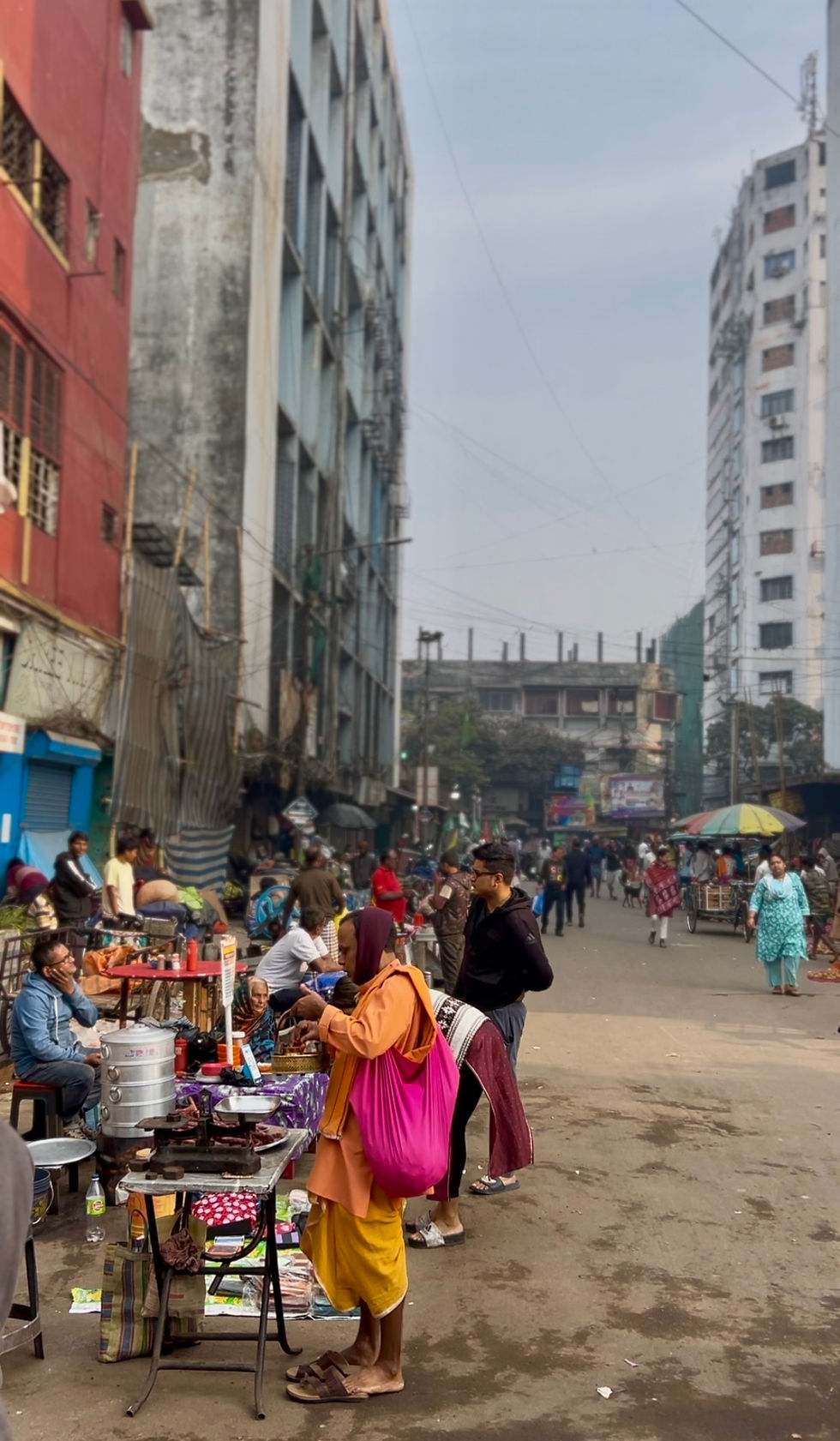
I was headed to Tiretta Bazaar, famous for its Chinese breakfast stalls. I walked through bylanes where some locals were frying what looked like pakoras on one side and butchers worked on the other— breakfast served with brutal transparency.
Across the road was a vegetable market, followed by Chinese breakfast stalls run by local sellers but cooked by Chinese families.

Shops at the back sold lap cheong sausages—pork cured with soy, wine, ajinomoto, and air-dried. I ate some fish siu mai; spongy, dense, and perfect with the two chilli pastes they serve. Breakfast accomplished. I did not see many Chinese families around, as I hear that they've mostly migrated to other countries from the ambassador's driver.
That evening, I ventured into the madness of New Market. Truly mad—juice sellers shouting, poultry flapping, phone covers in every colour known to man, cheap underwear, and buildings that hint at a far more glamorous past. Especially on Lindsay Street, where many structures were once lovely hotels and inns.


One such inn that still exists is the 200-year-old Fairlawn on Sudder Street, owned and run by the Sarkies back in the day. They also owned the Grand Hotel. Violet Smith was a legendary innkeeper, known as the eccentric grande dame of Fairlawn. She would hold court with her guests and host them every day. Her husband, Major Ted Smith, was in charge of the quality of continental fare from the kitchen and the overall administration. The Fairlawn during Mrs. Smith's time, has a brass gong in the dining hall, that rang at 7.30 am, 1 pm, 4 pm and 8 pm every day to announce breakfast, lunch, afternoon tea and dinner respectively. It was one of the few dining rooms of a hotel where guests were allotted tables by Mrs Smith and it was a random mix and match to get dinner table coversations going.
Fairlawn is now run by Elgin and has still kept that old-world charm alive. A chilled beer and some nuts, sitting on a verandah that has hosted guests and parties for over 200 years, run by exceptional innkeepers over time, what more could I ask for?
Dinner was golden fried bagda prawns at Flavours of China in Park St. The restaurant was packed on a Wednesday night, and as a solo diner, I was initially seated at a truly tragic little table next to the women’s washroom. Every thirty seconds, a lady would arrive at my table, pause briefly, and then disappear into the washroom. After a while, I decided this level of entertainment was far too much for a peaceful soul like myself. I asked to be moved and was promptly relocated between two couples, which felt marginally more dignified.

I then spent the next five minutes mentally noting how I could better enhance the solo diner’s experience across our own hotel operations, as we do have a fair number of single guests staying and dining with us.
The restaurant manager was another character altogether—publicly dressing down a couple of waiters and even sniffing their breath, presumably checking if they had enjoyed a quick one behind the bar. I quite like that Calcutta restaurants don’t serve peanuts with drinks, opting instead for local namkeen—far nicer than the boring peanuts that every hotel up north seems contractually obligated to serve.
The bagda golden prawns were enormous, steaming hot, and perfectly crisp. Washed down with a chilled Kingfisher, and I was done for the day. I did briefly consider dessert, but my conscience and pocket staged a joint protest.
I spent some time taking night pictures of the yellow taxis. Every sighting brought pure joy—the flash of yellow, the familiar engine sound, lemons and chillies hanging from mirrors, “No Refusal” proudly painted on doors, no mobile phones glued to dashboards, old-school drivers, working meters, and generous rear seats.

This, to me, is the true joy of the city. As I was leaving the city towards the airport to head to the Andaman Islands, I noticed tram tracks and wires but no trams. The driver said they’ve been removed and won’t return. He also mentioned his Ambassador’s documents were about to expire, though the car was perfectly fit—he repairs it himself. As I left Calcutta, I felt grateful to have seen what may be the last of the Ambassadors. They remain the true ambassadors of the City of Joy—and the ones that brought me the most joy on this trip.
Long live the Ambassador.
Varun Sankaran Kutty, Innkeeper.
Calcutta, February 2026


These observations are personal—formed over long walks, good meals, and the occasional strong opinion.
Written 8th February 2026 by Varun.
Varun Sankaran Kutty, VSK is an innkeeper devoted to innkeeping at distinctive hotels and thoughtful travel experiences across India. An India specialist hotel concierge, he was awarded the Golden Keys (Les Clefs d’Or) in 2016. Varun works with the teams at Jalakara in the South and The Innkeeping Co. in the North, and remains deeply grateful for the privilege of serving as an innkeeper to guests, colleagues, and the local communities that surround his work.
